
Firefight (Halo Infinite)
From Halopedia, the Halo wiki

In Halo Infinite, the Firefight gamemode was introduced into the game in the Winter Contingency III update in December 2023. Unlike Firefight in prior Halo games, Firefight in Halo Infinite is no longer an entirely separate experience to standard multiplayer: instead, it is now capable of being created in the game's Forge mode and custom game settings, by using gametype scripting and map editing to place down objectives and non-playable characters (NPCs).[1] While Firefight was first introduced as Firefight: King of the Hill, other modes such as Gruntpocalypse, Firefight Classic (a classic-style simple wave survival mode similar to Firefight in Halo 3: ODST), and third-person were later added to expand the experience.
Overview[edit]

Firefight in Halo Infinite is created using the AI Toolkit in Forge, a suite of features that integrates Campaign NPCs into the multiplayer sandbox. The system supports up to 32 active AI units at once, with 43 distinct NPC variants including Grunts, Jackals, Elites, Brutes, Hunters, and even High Value Target characters. These units can be deployed via standard spawners, drop pods, or Phantoms, the latter of which can also deliver piloted or unoccupied vehicles like Ghosts or Wraiths. Beyond standard enemies, players can add friendly NPCs by assigning them to any of eight different team allegiances, allowing NPCs to fight alongside players or against them. Players can customize AI attributes and behaviors through both Custom Game settings and Forge's Node Graph scripting engine; this extends to AI difficulty which can be set or scaled dynamically based on player count and mid-match scripts. Node Graphs scripting also enables AI movement across different zones as well as custom objectives for players like spawning friendly NPCs via a button press.[2]
Firefight gametypes[edit]
King of the Hill[edit]
The first iteration of Firefight introduced in Halo Infinite was a particular gamemode, Firefight: King of the Hill. Rather than the traditional Firefight mode's wave-based survival mode, King of the Hill is an objective-based Firefight experience similar to Halo 5: Guardians' Warzone Firefight experience. The mode takes influence from the eponymous King of the Hill multiplayer mode and requires players to defend a number of zones against several waves of enemies that spawn in turn. Players contest and capture hills against progressively difficult waves of enemies, thus shifting the focus from combat to a balance between defensive positioning and aggressive pushes to maintain hill progress.[1]
In each match, five pre-set hills located across the map spawn in a random order. To secure a point, players must fill a capture meter by occupying the hill and then defeat a final Boss Wave, which is led by a named High Value Target. The enemies can also capture the hill; if players are pushed out of the zone, the enemy will begin making their own progress toward capturing the point. A match is won if the players successfully captures at least three out of the five hills; conversely, even if players survive until the fifth hill was captured, the match ends in a loss if the AI enemies have captured three of the five hills. Resupply opportunities for ammunition and equipment are only available during the brief respite periods between hill transitions.[1]
Firefight: King of the Hill utilizes an elimination and revive mechanic. When a player is killed, they enter a downed state at their location and are placed on a lengthy respawn timer (with the duration dependent on difficulty level, though on Legendary, there is no timer, so downed players are only able to return to battle via revive or after a hill is captured). Teammates can manually revive downed players to bring them back into the fight immediately, and revived players are spawned in with default loadouts. If all players are downed at the same time, the match ends as a loss. Traditional life pool settings remain available as a toggle within Custom Game options for players seeking a classic experience.[1]
The mode introduces a streak-based system for skulls, which act as difficulty modifiers. Unlike previous games, where skulls were enabled in a fixed order based on time or round count, these modifiers are now earned through performance. If the players capture a hill without any player deaths, a semi-random skull is enabled for the next hill. These skulls stack, allowing for up to four active modifiers by the final objective. However, failure to capture a hill will break the streak and disable the most recently earned skull. This system is designed to naturally scale the challenge: flawless performance lead to progressively higher difficulty, whereas matches with more player deaths lead to fewer modifiers. By default, the primary skull pool includes Fog, Catch, Famine, Thunderstorm, Mythic, and Black Eye; secondary skulls such as Grunt Birthday Party, Boom, Cowbell, IWHBYD, and Bandana have a small chance to trigger at the start of a round.[1]
Firefight: Linear King of the Hill is an alternate version added in Champions Operation; in this version only available on certain maps, the hills always spawn in the same order, and players are confined to each room until the next one spawns.[3]
Third-person[edit]

In 2024's Great Journey Operation, a third-person viewmode was added to Firefight: King of the Hill. This marked the first time in an official Halo release that Firefight could be played in third-person (similar to early iterations of pre-Xbox Halo). While Firefight: King of the Hill was the first Matchmaking playlist to include this setting, the setting was also included in custom games for use in non-Firefight experiences.[4]
Battle of the Academy[edit]
- Main article: Firefight: Battle of the Academy
Firefight: Battle of the Academy was a limited-time playlist introduced in Operation Last Stand and available throughout summer 2025. It included two linear Firefight missions themed around the Battle of Nysa and tying in with two Halo Waypoint Chronicle short stories: Halo: Battle for the Academy - Part 1 and Halo: Battle for the Academy - Part 2. These missions are progressed through a variety of objectives on dedicated Forge maps exclusive to the playlist.
Firefight Classic[edit]
Firefight Classic, like in Halo 3: ODST and Halo: Reach, follows the same structure of waves, rounds, and sets over a potentially infinite duration. Players share the same life pool, starting with seven lives at the beginning of the match.[5]
A single round consists of five waves of enemies with escalating enemy difficulties. A set is completed after three full rounds, with teams rewarded with one extra life in the life pool. At the end of each set, there is a bonus round, during which all skulls are enabled, and deaths do not deplete the players' life pool. The team earns one extra life for successfully completing a set. Additionally, during bonus rounds, players can earn more lives at a rate of one per 1,000 points scored. Players are resupplied with ammunition and equipment between each round to prepare for the next wave of enemies. As players progress through a set, a new skull activates at the start of second round and another at the third round, stacking the gameplay modifiers to increase the difficulty.[5]
Halo Infinite's iteration of Firefight Classic introduces the Extraction mechanic, which allows players to voluntarily end a match without depleting the life pool. At the conclusion of each set, an extraction zone labeled "Complete the Mission" appears on the map. If at least two players enter this zone, the match ends. If the team chooses not to extract before the timer expires, they are committed to surviving the entirety of the next set or until the life pool is completely exhausted.[5]
Gauntlet[edit]


Firefight: Gauntlet introduces progression-based mechanics and objective-driven elimination to the traditional Firefight formula. This mode focuses on boss elimination to halt enemy reinforcements and secure passage to the next encounter across five areas connected by a central hub. Each battle arena is defended by endless waves of enemy forces, which can only be stopped by defeating the arena's champions. Waves within a battle arena will become more intense over time. As players progress through the map's five battle arenas, the difficulty level of the enemy AI will also increase. The match follows a linear path through five connected arenas; a total of five rounds must be successfully cleared to achieve victory.[6] While all five arenas are played in every match, the order of the maps, the composition of enemy waves, and the specific bosses encountered are randomized each match.[7]
Player can upgrade the character attributes in the supply area between rounds. In the hub, players can resupply ammunition, secure equipment, and acquire power weapons. They can also spend resources to level up personal upgrades across four categories:[6][7]
- Damage: increases the amount of damage dealt by a players weapon and melee attacks.
- Recovery: reduces the amount of time before a players shields and health begin restoring after taking damage.
- Resistance: increases the amount of damage that a players shields and health can take before the player is downed.
- Speed: increases the speed of all player actions, including player movement, reload speed, and recovery from performing melee attacks.
Each of the four player attributes listed above has its own four upgrade tiers. These tiers alternate between weak and strong upgrades. Players start with one upgrade point, and additional points can be earned by completing rounds or other special achievements.[7]
Enemies are driven by the "AI Aggro" system, which dynamically tracks enemy attention. Players generate attention by eliminating foes, and the individual with the highest "aggro" is marked as a VIP that would be prioritized by the bosses. The AI Aggro can be managed by equipment; deploying a Shroud Screen reduces aggro, using active camouflage temporarily removes all enemy aggro, and activating an overshield draws all enemy focus to that player. When a player is downed, they can be revived; otherwise, they will automatically respawn after a 30-second delay. If all players are downed at the same time, the match ends as a loss.[7]
Success in each arena requires the elimination of the boss. These bosses must be defeated to halt the endless reinforcements of standard enemies. Upon their defeat, the boss' weapon becomes available in the next restock of the hub's weapon slots; they can be be retrieved from the armory multiple times in a match, including repeated use by the same player or different players. If the players take too long to eliminate the bosses, the Harbinger will spawn, significantly increasing the difficulty. To further raise the stakes, players can retrieve an Oddball from the Harbinger and return it to the hub to activate difficulty-increasing skulls, which in turn boosts the team's personal score.[7]
Production notes[edit]
The Halo Waypoint Chronicle Halo: Trial of Reckoning was released in conjunction with Firefight: King of the Hill mode. It draws parallels with the game mode, down to the story being set in the House of Reckoning, while the eponymous map was introduced specifically for the game mode. Similar to a typical match of Firefight: King of the Hill with four players, the four survivors are tasked with capturing and holding hills from enemy waves, with Escharum even explicitly namedropping "king of the hill" when explaining the trial in the story.
Gallery[edit]
Menu images[edit]

Playlist image for Firefight: King of the Hill Normal.

Playlist image for Firefight: King of the Hill Heroic.

Playlist image for Firefight: King of the Hill Legendary.

Menu image for Firefight: King of the Hill.
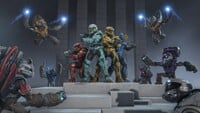
Menu image for Gruntpocalypse.
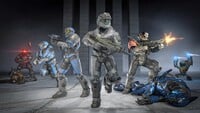
Playlist image for Firefight: Battle for Reach.
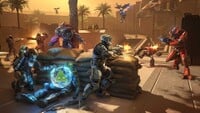
Playlist image for Firefight Classic.

Playlist image for Firefight: Battle of the Academy.

Playlist image for Firefight: Gauntlet.


Screenshots[edit]


Sources[edit]
- ^ a b c d e Halo Waypoint, Firefight: King of the Hill Preview (Retrieved on Jun 30, 2025) [archive]
- ^ Halo Waypoint, Forge Overview - Season 5 (Retrieved on Oct 20, 2023) [archive]
- ^ Halo Waypoint, Firefight: Battle for Reach (Retrieved on Sep 5, 2024) [archive]
- ^ Halo Waypoint, Playlist Overview - Great Journey (Retrieved on Oct 31, 2024) [archive]
- ^ a b c Halo Waypoint, Firefight Classic (Retrieved on Mar 12, 2025) [archive]
- ^ a b Halo Waypoint, Enter Firefight: Gauntlet (Retrieved on May 8, 2026) [archive]
- ^ a b c d e Halo Waypoint, Halo Infinite Firefight: Gauntlet Update - Patch Notes (Retrieved on May 5, 2026) [archive]
| |||||||||||


